wayyō’mərû lwō ’ĕmār-nā’ šibōleṯ wayyō’mer sibōleṯ wəlō’ yāḵîn ləḏabēr kēn (Judges 12:6)
They said to him, ‘Then say Shibboleth’, and he said, ‘Sibboleth’, for he could not pronounce it right.
Showing posts with label Intro. Show all posts
Showing posts with label Intro. Show all posts
Monday, June 16, 2008

Friday, May 16, 2008
Flashcards
Is there a better way to learn vocabulary other than flashcards? Well, I guess there's immersion (the linguistic kind, not the baptismal kind), and maybe divine foreknowledge, which neither you nor I are likely to have. So whether you make your own, install the Teknia program (which I can't get to work on my computer), use Davar, or—my recommendation—buy the Van Pelt flashcards, it's time to get flashing.
(I'll abbreviate the Van Pelt flashcards as VPF# at this blog, so, for instance, VPF 10 = Van Pelt flashcard number 10.)
(I'll abbreviate the Van Pelt flashcards as VPF# at this blog, so, for instance, VPF 10 = Van Pelt flashcard number 10.)
Update: Here's a very cool flashcards website.
Textbooks
* = recommended
Books
* Cook, John and Robert Holmstedt. Ancient Hebrew: A Student Grammar (Unpublished PDF draft, 2007)
* Dobson, John. Learn Biblical Hebrew (Baker Academic, 2005)
Kelley, Page. Biblical Hebrew: An Introductory Grammar (Eerdmans, 1992)
Kittel, Bonnie P.; Vicki Hoffer; and Rebecca A. Wright. Biblical Hebrew: Text and Workbook (Yale, 1989)
Lambdin, Thomas. Introduction to Biblical Hebrew (Prentice Hall, 1971)
* Pratico, Gary and Miles Van Pelt. Basics of Biblical Hebrew Grammmar (Zondervan, 2001) (W) (buy)
Ross, Allen. Introducing Biblical Hebrew (Baker Academic, 2001)
Seow, C.L. A Grammar for Biblical Hebrew (Abingdon Press, 1995)
Waltke, Bruce and Michael O'Connor. An Introduction to Biblical Hebrew Syntax (Eisenbrauns, 1990)
• Annotated reviews and companion resources from Tyler Williams
Websites
Concordia
Eby
* Milingua
* Parsons
Poulos
Williams (unpublished study guide to Lambdin)
Transliteration
To avoid all the problems of font and browser displays of the Hebrew alphabet, I thiink I'm going to opt for transliteration at this blog. But remember, the characters of the actual Hebrew alphabet are only a click away.
Granted, transliteration can actually be a barrier to getting familiar with the Hebrew alphabet (which is why Cook and Dobson, which use only the Hebrew alphabet for Hebrew, are more intuitive). But I've also found that at this stage, transliteration is one helpful measure to make sure I'm getting the pronunciation right of the Hebrew letters and words.
My own transliteration scheme is simplistic and imprecise (which, in a way, is a good reminder that romanization is only an approximation of Hebrew sound--plus, of course, we don't know what Ancient Hebrew actually sounded like). For verses, I tend to use the transliteration from Sacred Texts, which appears to use ISO 259.
(Update: I've realized another benefit of transliteration: it makes Hebrew sounds feel more like words. That, of course, is purely my bias and limitation as someone whose native language and other languages I've studied use the Roman alphabet. But the danger in reading a non-native alphabet is that it feels like you're deciphering, not reading. Transliteration helps remind me that these are words and sentences, not just symbols.)
Here are some consonant transliteration guides from other textbooks:
Lambdin

Ross

Doukhan


Williams

Parsons

Also, while the point is to read Hebrew, not to write it, some textbooks have some helpful handwriting guides: see the guides from Cook and Ross
Granted, transliteration can actually be a barrier to getting familiar with the Hebrew alphabet (which is why Cook and Dobson, which use only the Hebrew alphabet for Hebrew, are more intuitive). But I've also found that at this stage, transliteration is one helpful measure to make sure I'm getting the pronunciation right of the Hebrew letters and words.
My own transliteration scheme is simplistic and imprecise (which, in a way, is a good reminder that romanization is only an approximation of Hebrew sound--plus, of course, we don't know what Ancient Hebrew actually sounded like). For verses, I tend to use the transliteration from Sacred Texts, which appears to use ISO 259.
(Update: I've realized another benefit of transliteration: it makes Hebrew sounds feel more like words. That, of course, is purely my bias and limitation as someone whose native language and other languages I've studied use the Roman alphabet. But the danger in reading a non-native alphabet is that it feels like you're deciphering, not reading. Transliteration helps remind me that these are words and sentences, not just symbols.)
Here are some consonant transliteration guides from other textbooks:
Lambdin

Ross

Doukhan


Williams

Parsons
Also, while the point is to read Hebrew, not to write it, some textbooks have some helpful handwriting guides: see the guides from Cook and Ross

Thursday, May 15, 2008
The Shear* Necessity of Lambdin
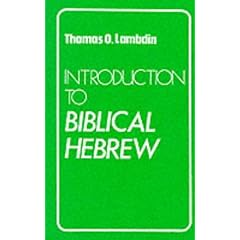 Thomas Lambdin's Introduction to Biblical Hebrew is not the best textbook for a first-year Hebrew class. But where I'm studying Hebrew it 's long been an immovable object, and as far as I know Jesus himself used Lambdin in Hebrew school, so I'll try to make the best of it. After I twice flunked the quiz for Lesson 3 I realized I had to get organized. Here it goes.
(* Yes, I realize the spelling "error" in the title of this post—it was supposed to be a sheep-related pun. Get it—Lamb-din? Never mind.)
Update: See my new Hebrew blog.
Subscribe to:
Posts (Atom)